
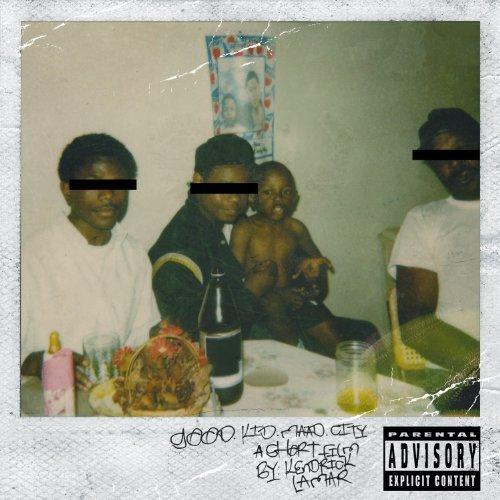
It’s Kendrick Lamar week in the rap world, and you can bet that a lot of us want to weigh in on good kid, m.A.A.D. city, an album title which is very confusing to punctuate. We kicked it off last week with Deen and should be continuing all week. Feel free to chime in, hate, ask your favorite writers for their take or just read and bail. Mad illumination, baby.
You have to read all the best books at least twice. The first time you arrive at Watchmen, Lolita, Miss Lonelyhearts (just to name a few), you speed through, racing, powered by excitement and the compulsion to find out what’s going to happen in the story.
I listened to Good Kid, M.a.a.D City quickly my first time through, motivated by excitement and the compulsion to figure out whether it was on par with Section 80. I ignored the sensible warning of Scott Leedy, listened quickly and reported back to any interested parties that it was a “mild disappointment.”
What an idiot.
GKMC is very different from our favorite album of 2011, in a way that demands a quick lesson in semantics. With Section 80, Kendrick posited himself as the voice for a generation, as a spokesman. The album started with a sermon about inclusion and continued in that vein. The songs were broad, blunt, anthemic, weighty. They seemed important.
GKMC is an entry from the voice of a generation. It comes from within, and represents by being, rather than by preaching. It achieves a subtlety that recent generation-voice declarees Kanye West and Lena Dunham have yet to display and which Kendrick hasn’t shown before. It’s a segmented album with songs as chapters, chapters which reveal a nonlinear, multi-perspective morality tale, which takes more than a couple of listens to imbibe.
I still haven’t pieced every last segment together but I can key in on the tracks that are most integral to the story. Our orientation begins with a description of the temptress and the tempters. The former’s name is Sherane. She is sexually aggressive and insanely sexy, the kind of girl who upon meeting you doesn’t hesitate to call you cute, and then wraps her leg around you a couple hours later. She might just live in Compton, but she wouldn’t want you to be turned away by that.
The tempters are your friends. You all want to live “like rappers do,” not by being rappers but by robbing houses. By smoking blunts, one of them powdered over with “shenanigans.” You’re not used to getting high, but when you’re “with the homies” it doesn’t seem like such a big deal. And even though you don’t do this often, they respect you anyway, because, hey, you’re pretty good with girls and cottdamn you can flow. Everyone’s heard that “Backseat Freestyle.”
Kendrick is trapped. Even when these friends aren’t tempting him he can’t help but to get in trouble. “Good Kid” tells of two unprompted encounters, both of which leave Kendrick bloody. The first is with some gang members who see him leaving bible study. The second is with some racial-profiling cops. Red and blue are prominent in both scenarios and so is unwarranted violence, done to a good kid. “M.A.A.D. City” switches things up, telling the story of a gang member who saw a friend shoot a light-skinned kid in the head, and can’t see his friend the same way anymore. For the album’s purpose, Kendrick could easily be that kid.
Violence everywhere, friends and girlfriends as dangerous as enemies. Kendrick emerged from the morass for two reasons. The more interesting one is revealed on a thematic companion to Eminem’s “Stan,” the devastating “Sing About Me, I’m Dying of Thirst.” And that’s the desire to live for other people, to represent their stories to the world. To be the voice for a group of lost kids from Compton. To care about your fans so much that their voices make it into your songs is a sign of uncommon empathy, especially in an industry in which being a callous is a carefully refined skill.
The other reason is simple, boring, and important. It’s family. Kendrick’s mother and father appear throughout the album. They are embarrassing, ridiculous, and annoying, as family can so often be. They are occasionally amusing. But before the album ends, Kendrick’s mother (who has been trying to take her van back from him for the entirety of the album, so that she can make an important appointment to do right by her kin) administers a benediction to the sinners. It’s as preachy as anything on Section 80 but as it comes from a person other than Kendrick, near the end of an album during which Kendrick has told stories about grief, alcoholism (“Swimming Pools (Drank)”) lust for money and sex and heaps of violence, it’s a welcome relief.
I’ve summarized, more than I’ve criticized and there’s a reason for that. I’m sure you guys are aware that this album is great. Reviews came out yesterday and today. Grantland compared it to Illmatic, The Third Man, and The Great Gatsby. Pitchfork gave it the kind of praise that they usually reserve for rappers named West. If good is the measuring marker, then yeah, sure, this album is good and you can tell your friends. If you’re looking for the ole hyperbolic comparison: It’s Fargo as a rap album. Hyper-linguistic with regional specifics and a good old fashioned biblical morality tale bathed in modern ultraviolence.
But more than just good, this album is dense. It takes time. There might be a detail that I’ve missed lurking on one of the songs that unravels the entire plot, that lays everything out plainly. There could be an entire character that no one has noticed yet. I can’t say and I don’t want to engage in the same act of preemptive stupidity twice. So all I can say for sure, is that this is an album to listen to again. And again. And again. And again. And…
